
Understanding and Measuring the Impact of Entrepreneur Support Organizations (ESOs)
What Entrepreneur Support Organization (ESOs) are.
ESOs provide the infrastructure that helps entrepreneurs start, sustain, and grow their businesses.
They offer a range of support such as education and mentorship, access to capital, technical assistance, peer networks, and help with navigating administrative barriers. ESOs often provide the only accessible pathway to entrepreneurship for people who face systemic barriers to resources such as credit, capital, technical skills, and professional networks.
Unlike many traditional business accelerators that require an ownership stake or equity in the entrepreneurs’ ventures, mission-driven ESOs focus on community impact and equitable access to opportunity rather than financial return. They see entrepreneurship as a way to build wealth in communities that face systemic barriers to financial success.
What typical metrics leave behind.
Most current guidance for the measurement of entrepreneurship and businesses is skewed toward a narrow set of financial indicators, such as annual revenue, staff size, and debt-to-income ratio.
This limited viewpoint is mirrored in guidance for ESOs, which are encouraged to prioritize serving the largest number of entrepreneurs at the lowest cost, and the speed with which businesses repay their loans.
In our experience, these metrics-as-usual miss the real story of ESOs and the entrepreneurs they support. In some communities, success means stabilizing small family-run businesses that sustain local culture; in others, it may mean preserving the variety of local businesses. In communities of color and communities facing economic disinvestment, success may also mean reclaiming ownership of neighborhood assets, strengthening social capital, or resisting displacement through community-rooted entrepreneurship.
Tip: Use personas and journey maps to help identify the ways that different entrepreneurs define success and connect outcomes for themselves and their businesses.
A more holistic view of ESOs.
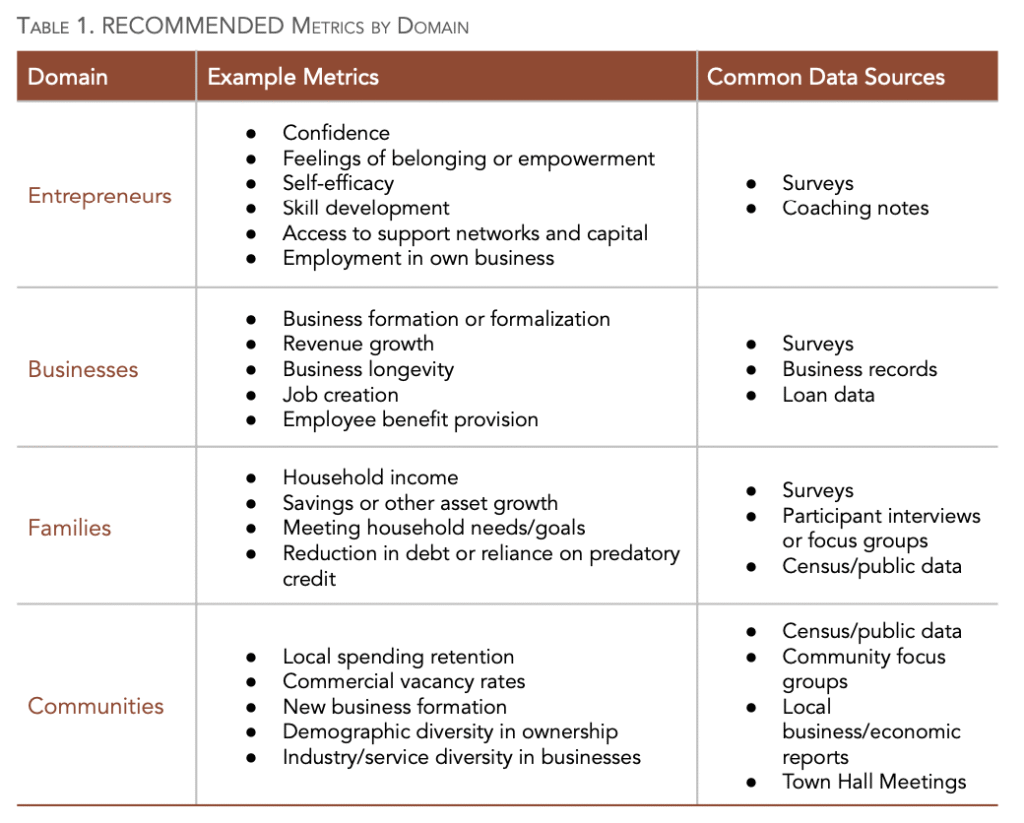
We recommend that ESOs use a mix of indicators, including entrepreneurial ecosystem metrics such as diversity of capital sources and network connectivity, as well as inclusive entrepreneurship indicators like the share of women- or BIPOC-owned businesses supported.
Personal financial wellbeing metrics, such as changes in debt levels, savings, or credit scores, provide insight into individual outcomes, while community level indicators like local job retention and business survival during downturns help capture broader systemic effects.
ESOs can further strengthen their story of impact by tracking more locally- and contextually-rooted measures such as the diversity of business ownership or entrepreneurs’ sense of belonging and self-efficacy. Together, these measures offer a more complete picture of impact that honors both individual progress and collective resilience.
Enhancing rigor through co-creating success metrics.
Co-design evaluation metrics with ESOs and entrepreneurs to ensure that measures of success accurately reflect their goals for their own companies, rather than presupposing that financial return is all that they value. Partnering directly with entrepreneurs from historically marginalized backgrounds in the design of metrics helps ensure that evaluation frameworks reflect their lived experience and community definitions of success. This approach recognizes that entrepreneurs closest to these challenges hold the expertise to define what success means and how it should be measured.
DOWNLOAD UNDERSTANDING AND MEASURING THE IMPACT OF ESOS
AEA365 BLOG POST